How Brand Drift Silently Kills Boutique Fitness Studio Retention
The average boutique fitness studio loses
7.5% of its members every month.
Run that number forward: over 13 months,
you've replaced your entire client base.
You're not growing. You're surviving.
Replacing the people you already paid to acquire, at a cost that doesn't get cheaper.
Most operators look for the obvious culprit. Pricing. A new competitor nearby. Life changes pulling members away.
Sometimes that's accurate.
But there's a quieter reason studios bleed members that almost nobody in the industry talks about directly: brand drift.
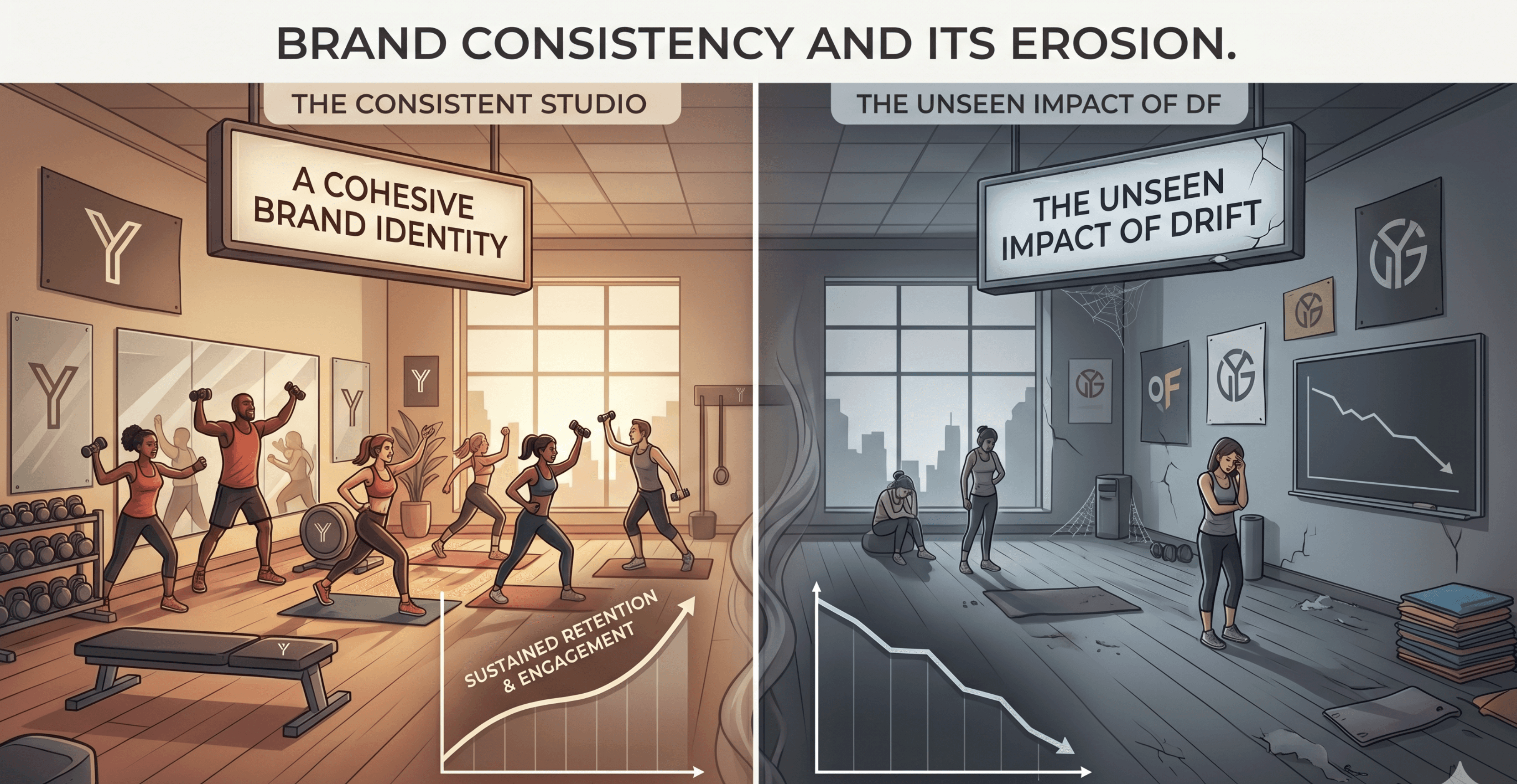
Not a logo crisis. Not a rebrand moment. The slow, invisible erosion of what made your studio feel like yours happening gradually, at every touchpoint, until the experience that justified the premium stops delivering it.
By the time most founders notice it, they've already lost people they shouldn't have.
What Brand Drift Actually Looks Like
Brand drift doesn't announce itself. That's what makes it dangerous.
It starts with one staff member who describes the studio differently to a prospect than you would. Then another trainer whose communication style doesn't quite match the premium experience you built everything around. Then a follow-up email that sounds like it came from a different business. Then a few social posts that look fine individually but feel slightly off as a sequence.
None of these are catastrophic in isolation. Together, they create an experience that doesn't quite cohere.
Members notice before they can name it. A member who signed up because your studio felt different - worth the extra €50 a month over the gym down the road starts to wonder if it still does. The feeling fades. The decision to stay becomes a calculation instead of a reflex.
At premium pricing, calculations don't hold
for long.
Why Retention Is a Brand Problem, Not Just a Product Problem
The fitness industry has spent years optimising the product: coaches, programming, equipment, recovery add-ons, community events.
All of it matters.
But there's a gap between what studios deliver and what members experience over time and it's rarely about the quality of the class.
It's about the accumulation of small inconsistencies that add up to a feeling of drift.
Members who can clearly articulate why a studio is different from every other option stay longer, resist price increases, and refer more.
Referrals convert at 41% in boutique fitness the highest of any acquisition channel. But referrals only flow at that rate when members can say, clearly, what they love.
Brand drift corrodes that articulation. Members feel it, they just can't say it. When they can't say it, they don't refer.
When they don't refer, acquisition costs climb. When costs climb, margins compress. When margins compress, you cut things that matter.
And the drift accelerates.
This is a retention loop. It starts with brand.
The Two Moments Brand Drift Becomes a Real Threat
Brand drift is a background risk in any studio. But there are two specific moments where it shifts from a slow leak to a structural problem.
When the founder steps back from daily operations.
In the early days, brand consistency exists because the founder is everywhere. Coaching, hiring, writing the emails, approving the content.
They're the brand, in the room, holding everything together through presence and instinct. When the founder steps back, that informal
standard disappears.
No one has a brief. No one knows what "on brand" actually means, because it was never
written down.
What was carried by a person now needs to be carried by a system. Most studios don't have one.
When you open a second location.
The second location is where brand drift stops being a slow leak and starts showing up on the revenue line.
Different staff culture, different space, slightly different pricing communication, a different feel
to the experience.
Members from Location 1 who visit Location 2 sense the inconsistency immediately.
New members at Location 2 are getting a different experience from what the website and social media promised. The premium positioning that justified the price starts to fragment.
Both moments share the same root cause: brand consistency was carried by people, not by a system.
What Consistency Actually Protects
It's worth being specific about what brand consistency does for retention, because it's easy to make this feel abstract when the real impact
is concrete.
Consistent positioning means every touchpoint lands the same way. The website, the induction email, the class briefing, the way staff describe the offer — they all reinforce the same thing. Members know exactly what they signed up for. That clarity builds trust, and trust reduces the moment where staying becomes a calculation.
Consistent visual identity signals that the business is intentional. When the brand looks considered at every touchpoint not just inside the studio. Members apply that same standard to the rest of the experience. The aesthetics create an expectation, and then the experience meets it.
Consistent communication tone means
follow-up messages, renewal reminders, and social content all sound like the same business.
Members feel like they have a relationship with something that knows itself.
Studios that hold all three consistently see lower churn, higher referral rates, and real pricing power.
Life Time Fitness generates $815 in average monthly revenue per member not because its classes are objectively superior, but because the experience is coherent from first contact to
year three.
Consistency isn't a design preference. It's a retention mechanism.
How to Know If Brand Drift Is Already Happening
The signs are quiet. Here's what to look for.
New members are joining but citing a different reason than the one you built the brand around. Retention holds for six months, then drops.
Staff at different locations describe the offer slightly differently when asked cold. Your last three social posts feel like they came from different studios. A referred member says the studio "wasn't quite what they expected."
Any of these is worth pausing on. More than two is a signal worth acting on.
If you want a faster read on where the gaps are, run your studio through the BrandPerform scan at brandperform.co. It audits how your brand comes across online — tone, consistency, positioning — in about 10 seconds. Free, no form, no call required.
The Fix Isn't a Rebrand
Brand drift doesn't require a rebrand to solve. Most studios with this problem don't need new logos. They need a brand system: documented standards for how the brand sounds, looks, and behaves that exist independently of any one person.
That means written positioning. Defined tone of voice. Visual rules that don't depend on who's creating the content that week.
Clear language for how staff describe the offer. Onboarding materials that carry the brand, not just the logistics.
When those systems exist, brand consistency doesn't depend on the founder being in the room. It holds at two locations. It holds when new staff join. It holds three years in, when the early-adopter energy has worn off and the brand needs to do the work of keeping people.
Studios with brand systems retain members longer. They convert referrals at higher rates. They justify premium pricing without having to defend it. And when they scale, what they built doesn't quietly come apart.
That's not a design outcome.
That's a revenue outcome.
Studio Biocus® builds Performance Brand Systems for premium fitness operators scaling beyond a single location. Based in Berlin.
Working with a founding cohort of operators globally. studiobiocus.co
Stay ahead in the health and wellness world with expert insights on branding, design, and marketing.