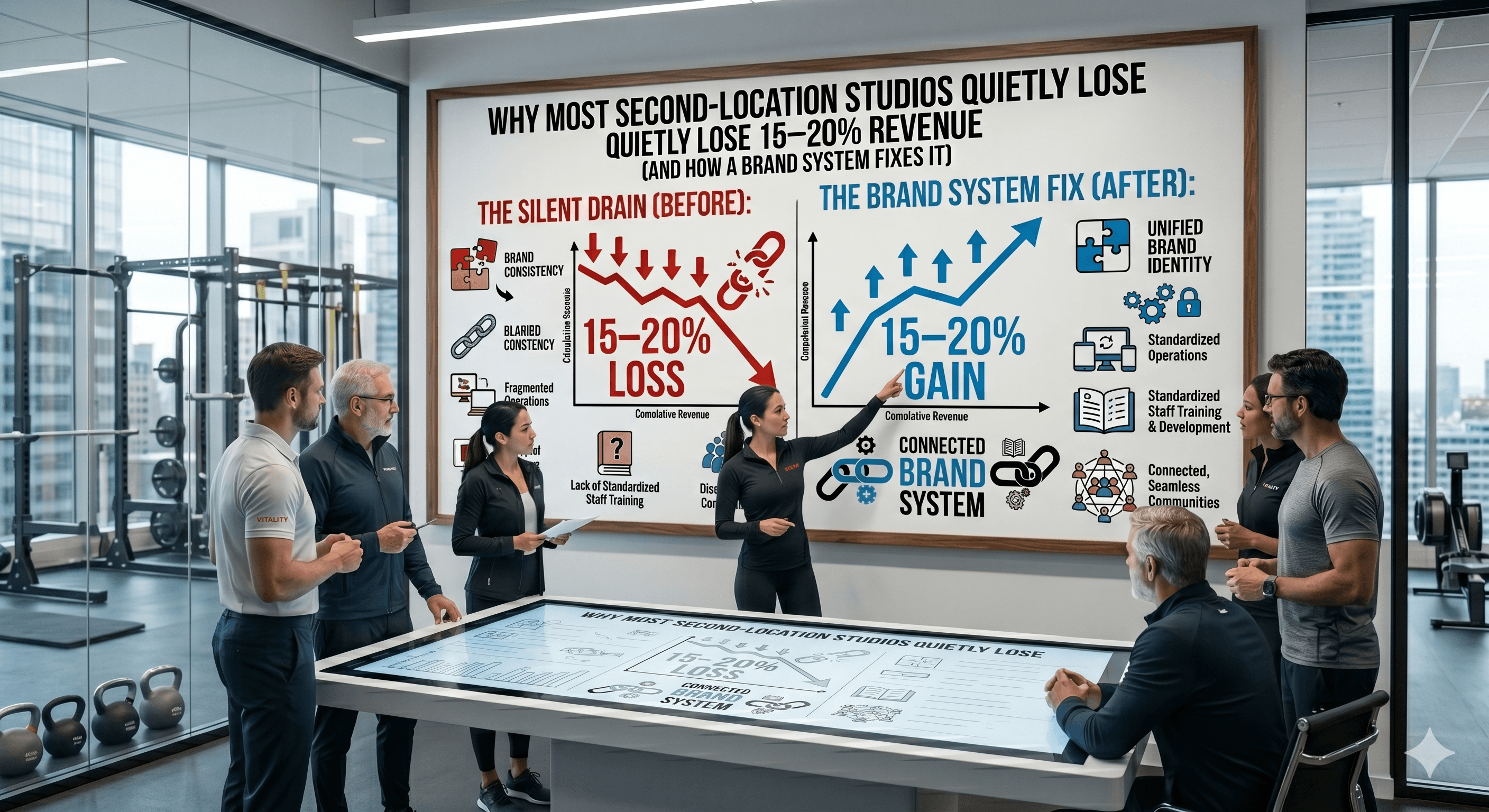
Why Most Second-Location Studios Quietly Lose 15–20% Revenue (And How a Brand System Fixes It)
Opening a second location should feel like proof.
Proof the model works. Proof the experience is repeatable. Proof the first studio wasn't just luck.
For most boutique founders, it starts exactly that way. The new space is ready. The team is hired. The launch goes well. And then, a few months in, something feels slightly off.
Nothing catastrophic. Just a quiet erosion.
Retention at location two runs a few points lower than location one. Referral conversion feels harder. The social presence looks close — but not quite right. A coach at the new space describes the studio slightly differently to a prospect, and nobody catches it. The website still tells the story of the original location.
By the time the founder notices, the gap has already cost them.
What Brand Drift Actually Is
Most operators think of brand drift as a design problem. A visual inconsistency. A logo used in the wrong weight.
It's a revenue problem.
When a member at your first location refers a friend, that friend does exactly what every prospect does: they search. They look at the website, scroll the Instagram, check the Google profile. And if what they find doesn't match the experience their friend described, the doubt starts before they've ever walked in.
That doubt costs you the booking.
When a new member at location two forms their first impression, they're comparing what they see online to what they feel in the room. If those two things don't match, trust doesn't fully form in the critical first 90 days.
That doubt costs you the renewal.
This is brand drift. Not a visual inconsistency. A gap between the experience you deliver and the story the outside world sees — and it compounds silently across every new touchpoint you add.
Three Places the Revenue Leaks
1. Referrals that never book
Referrals are still the highest-converting acquisition channel in boutique fitness, driving roughly 41% of new members for premium studios. They convert at a higher rate than any paid channel because they carry trust built by someone who already loves the experience.
But that trust only transfers if the external brand backs it up.
When the referred prospect checks your studio online and finds inconsistent visuals, a website that feels like it belongs to a different business, or messaging that doesn't match the premium experience they were promised, they keep shopping. The referral doesn't book. And you never know why.
2. Churn in the first 90 days
Industry data consistently shows that most member churn happens before the 90-day mark. Before habits have formed. Before loyalty has a chance to build.
The single biggest driver of early churn isn't programme quality. It's the gap between expectation and reality. And expectations are formed long before the first class, based entirely on what the member saw online and in the booking flow.
If your external brand communicates one thing and your in-studio experience delivers another — even if the studio is genuinely better than the brand suggests — that mismatch creates doubt. Doubt becomes distance. Distance becomes a cancellation.
With annual retention already sitting at an average of 66.4% across the industry, studios cannot afford to accelerate churn through a brand experience that undersells what they actually deliver.
3. The pricing conversation gets harder
Studios with strong, consistent brands raise prices without pushback. Studios without them get compared on features.
At location two, this problem accelerates. New team members don't instinctively know how to position the premium. The messaging varies depending on who's speaking. Prospects in a new market have no existing perception to draw on, so they fall back on the only comparison they can make: price.
The pricing ceiling at location two is almost always lower than at location one. The experience is often identical. The brand just hasn't caught up.
Why Location Two Is Where the Gap Becomes Expensive
At location one, the founder is present. They carry the standard. Every new hire gets briefed directly. Every inconsistency gets caught because the person who built the thing is in the room.
At location two, that's no longer true.
The brand either travels or it doesn't. And without a documented system defining what on-brand looks, sounds, and feels like, it almost always drifts. Not dramatically. A thousand small workarounds: the social post that was close enough, the class description written in a slightly different voice, the signage ordered without checking.
None of those feel like problems in the moment. Together, over months, they are.
The founder ends up back in every conversation, correcting drift instead of building. And the second location never quite feels like the first.
What a Brand System Actually Does
A brand system isn't a style guide collecting dust in a Google Drive.
It's the infrastructure that makes the premium repeatable without the founder holding every detail.
Done properly, it covers four things:
Positioning: a single, specific reason why this studio is worth the premium — clear enough that any team member can articulate it without thinking
Visual identity: a complete, documented system any designer can execute without guessing
Messaging: language that works consistently across every touchpoint — website, social, staff communication, booking flow
Experience: the specific moments that build trust before, during, and after a member's first visit
When those four are aligned, the second location feels like the first. Members form expectations from the external brand and find them confirmed inside. Referrals convert because the story holds up under scrutiny. Pricing conversations become easier because there's a clear reason to pay more.
Retention at location two stops running lower than location one. And the founder stops being the bottleneck.
Where to Start
The fastest way to know whether brand drift is already costing you is to see how your studio reads from the outside.
Most founders assume the gap is smaller than it is. They're inside the experience every day. They know what the brand is meant to feel like. The prospect who finds you through a referral or a Google search doesn't have that context.
Run a free brand scan at brandperform.co. Enter your URL and get an instant read on how your studio's brand holds up across the touchpoints that matter. It takes ten seconds.
If the score reveals gaps worth addressing before you open the next location, or before the current drift compounds further, book a 30-minute diagnostic call. No pitch. Just a clear look at where the revenue is leaking and what it would take to close it.
The second location was supposed to prove the model works.
A brand system is what makes sure it does.
Studio Biocus® builds Performance Brand Systems for premium fitness operators scaling beyond a single location. Based in Berlin. Working with a founding cohort of operators globally. studiobiocus.co
Stay ahead in the health and wellness world with expert insights on branding, design, and marketing.